
4 MIN READ
In Chinese tradition, calligraphy is not only an art of the hand.
It is an art of the whole body.
A single brush stroke may look simple on the page, but behind it there is posture, breath, timing, pressure, direction, and intention. The brush does not move by itself. It receives the state of the person holding it.
This is one reason Chinese calligraphy has often been understood as a form of cultivation. It trains more than technical skill. It asks the practitioner to become present, grounded, and quietly awake.
The same can be said of internal martial arts such as Taijiquan.
Softness, structure, and intention
In Taijiquan, movement is not forced from the outside. The body learns to release unnecessary tension, connect the whole frame, and allow movement to arise with clarity.
In calligraphy, the brush follows a similar principle.
A stroke cannot be stiff, yet it cannot collapse. It must be relaxed, but not weak. It must be alive, but not uncontrolled.
The hand moves, but the movement begins deeper than the hand. It begins from attention.
When the body is tense, the stroke becomes tense.
When the mind is scattered, the line becomes uncertain.
When the breath settles, the brush begins to move differently.
This is why a calligraphy stroke is never just a line. It carries the condition of the person writing.
Professor Cheng Man Ching and the Five Excellences
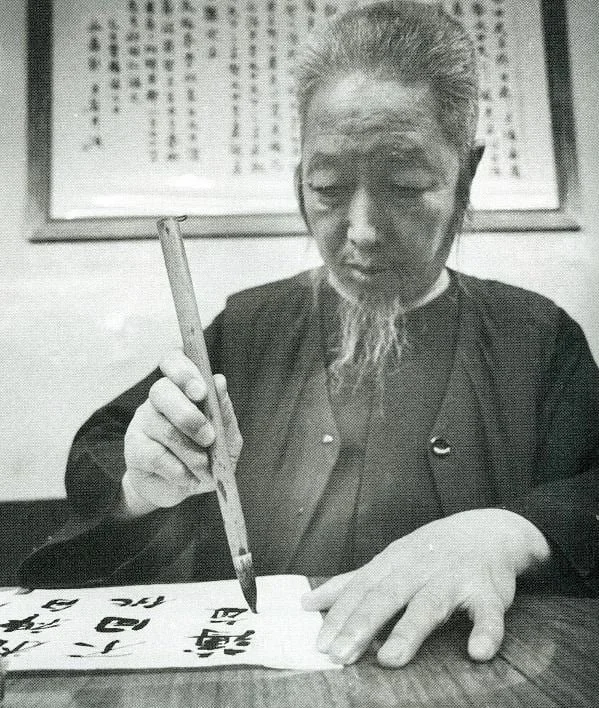
Professor Cheng Man Ching writing with a brush, reflecting the shared world of Chinese calligraphy, Taijiquan, and traditional cultivation.
A beautiful example of this connection can be found in Professor Cheng Man Ching, also known as Zheng Manqing.
Cheng Man Ching is widely remembered as a master of Taijiquan, but he was also deeply involved in the traditional Chinese arts. He became known as the “Master of Five Excellences 五絕老人” for his work in Chinese medicine, poetry, painting, calligraphy, and Taijiquan.
This is meaningful because, in the older Chinese view, these arts were not separate hobbies. They were different expressions of one cultivated life.
The brush, the body, the breath, the poem, the painting, and the movement all belonged to the same inner training.
Cheng’s life reminds us that Taijiquan was not only a martial practice, and calligraphy was not only decorative writing. Both could become ways of refining the person.
The stroke reveals the mind
There is a quiet honesty in calligraphy.
A brush stroke cannot be edited in the same way as typed words. Once the brush touches the paper, the movement is recorded. Hesitation, confidence, pressure, softness, speed, and stillness all remain visible.
This is similar to internal martial arts practice. A movement may look calm from the outside, but it reveals whether the body is connected, whether the breath is settled, and whether the intention is clear.
In both arts, the aim is not to add more effort.
The aim is to remove what is unnecessary.
Less force.
Less tension.
Less rushing.
More awareness.
A quiet practice of cultivation
For beginners, this connection can be very encouraging.
You do not need to understand everything at once. You begin with one stroke, one breath, one moment of attention.
The brush teaches patience.
The body teaches balance.
The page shows us where we are.
And over time, calligraphy becomes more than writing. It becomes a way to observe how we move, how we think, and how we return to ourselves.
In this sense, the art of the brush and the art of internal movement meet in the same place:
stillness within movement,
softness with structure,
and intention made visible.
Sources and Further Reading
Museum of Chinese in America — Cheng Man-Ching Collections at MOCA
Tai Chi Foundation — Cheng Man Ching
Taiji Forum — Professor Cheng Man Ching: Master of Five Excellences
